Introduction
The terms entity compliance and entity management are often used interchangeably—but they represent two distinct aspects of managing legal entities.
For organizations with even moderate complexity, understanding the difference is critical. Confusing the two can lead to gaps in systems, missed filings, and operational risk.
This article breaks down:
- What entity management is
- What entity compliance is
- How they differ
- Why organizations need both
- How modern systems bring them together
What is entity management?
Entity management refers to the process of organizing, maintaining, and updating information about legal entities.
It is focused on structure, records, and data.
This includes:
- Entity names and formation details
- Ownership structures and hierarchies
- Corporate governance documents
- Formation documents and certificates
- Organizational charts
Entity management answers the question:
“What entities do we have, and how are they structured?”
What is entity compliance?
Entity compliance refers to ensuring that legal entities meet all regulatory requirements necessary to remain in good standing.
It is focused on deadlines, filings, and obligations.
This includes:
- Filing annual reports
- Maintaining registered agents
- Submitting state-required updates
- Tracking jurisdictional requirements
- Monitoring compliance status
Entity compliance answers the question:
“Are our entities meeting their legal obligations?”
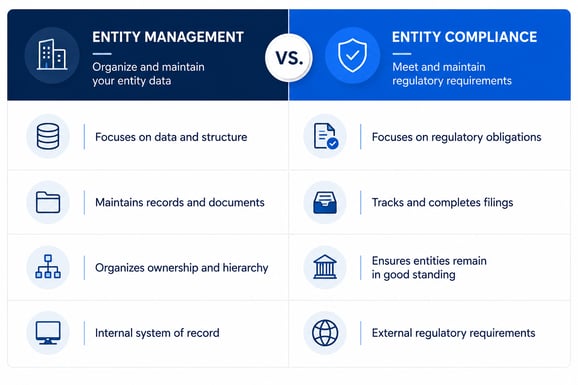
Key differences between entity management and compliance
While related, these functions serve different purposes.
Why organizations need both
Many organizations initially focus on one and neglect the other.
This creates gaps.
Without entity management
- Entity data becomes fragmented
- Ownership structures are unclear
- Documents are difficult to locate
Without entity compliance
- Deadlines are missed
- Entities fall out of good standing
- Legal and operational risks increase
Without integration
Even when both exist, they are often:
- Managed in separate systems
- Owned by different teams
- Not connected operationally
This leads to inefficiency and risk.
Where companies get it wrong
A common mistake is assuming that:
Entity management systems handle compliance
OR
Compliance tools manage entity data
In reality:
- Entity management systems often lack compliance tracking
- Compliance tools often lack full entity record keeping
This creates:
- Duplicate systems
- Manual coordination
- Data inconsistencies
Real-world example
Consider a company expanding into multiple states.
Entity management tasks:
- Creating new entities
- Recording ownership structure
- Storing formation documents
Compliance tasks:
- Filing annual reports
- Registering in new states
- Maintaining good standing
If these systems are separate:
- Teams must coordinate manually
- Data must be updated in multiple places
- Visibility is limited
How complexity increases over time
As organizations grow:
- More entities are created
- More jurisdictions are added
- More compliance requirements emerge
At small scale:
- Manual processes may work
At larger scale:
- Systems must be integrated
Traditional approaches vs modern systems
Traditional approach
- Entity management system → tracks data
- Compliance tools → track deadlines
- Service providers → execute filings
This creates fragmentation.
Modern approach
Leading organizations are moving toward systems that:
- Manage entity data
- Track compliance requirements
- Execute filings
All in one place.
Benefits of combining entity management and compliance
When these functions are integrated:
1. Improved visibility
- Single source of truth
- Real-time compliance status
2. Reduced risk
- Fewer missed deadlines
- Consistent processes
3. Operational efficiency
- Less manual coordination
- Fewer duplicated efforts
4. Scalability
- Systems grow with the organization
- Processes remain consistent
When do you need integrated systems?
Organizations typically reach this point when:
- They manage multiple entities
- They operate across jurisdictions
- Compliance becomes difficult to track manually
- Teams are spending too much time coordinating
Frequently asked questions
Is entity management software the same as compliance software?
No. Entity management focuses on records and structure, while compliance focuses on filings and obligations. Some platforms combine both.
Which is more important?
Both are critical. One ensures visibility, the other ensures legal compliance.
Can compliance be managed without entity management?
Not effectively. Without accurate entity data, compliance becomes unreliable.
What is the biggest risk of separating them?
Fragmentation—leading to errors, missed deadlines, and inconsistent data.
Final thoughts
Entity management and entity compliance are distinct but deeply connected functions.
Organizations that treat them separately often struggle with visibility, coordination, and risk.
Modern systems bring them together—creating a more efficient, scalable approach to managing entities.