

Introduction
As organizations grow, managing legal entities becomes significantly more complex.
What starts as a handful of entities quickly turns into dozens—sometimes hundreds—spread across multiple jurisdictions. Each entity comes with its own set of compliance requirements, deadlines, and filings that must be maintained to remain in good standing.
For many organizations, this process is still managed through spreadsheets, external vendors, and manual workflows.
Entity compliance software exists to solve this problem.
It provides a structured, centralized way to track, manage, and increasingly execute compliance requirements—reducing risk and operational burden.
What is entity compliance?
Entity compliance refers to the process of ensuring that a legal entity meets all regulatory and administrative requirements required by the jurisdiction in which it operates.
These requirements vary by state or country but typically include:
- Filing annual or periodic reports
- Maintaining a registered agent
- Updating entity information (address, officers, ownership)
- Submitting required state filings
- Maintaining licenses or registrations
Each jurisdiction has its own rules and deadlines. Missing a requirement can result in:
- Late fees or financial penalties
- Loss of good standing
- Administrative dissolution of the entity
- Inability to legally operate in that jurisdiction
For organizations with multiple entities, compliance is not just administrative—it’s critical to ongoing operations.
What is entity compliance software?
Entity compliance software is a system designed to help organizations track, manage, and organize compliance requirements across one or more legal entities.
At a basic level, these systems allow teams to:
- Store entity information and documents
- Track deadlines and filing requirements
- Monitor compliance status
- Receive alerts for upcoming obligations
More advanced platforms go further by:
- Automating compliance tracking
- Centralizing all entity-related data
- Providing reporting and visibility across entities
- Executing filings directly within the platform
These tools are typically used by:
- Legal and general counsel teams
- Finance and accounting teams
- Compliance and governance teams
The goal is to ensure consistency, reduce risk, and eliminate manual processes.
How companies manage compliance today
Before adopting dedicated systems, most organizations rely on a combination of methods.
Spreadsheets
Spreadsheets are often used to track:
- Entity names and structures
- Filing deadlines
- Compliance status
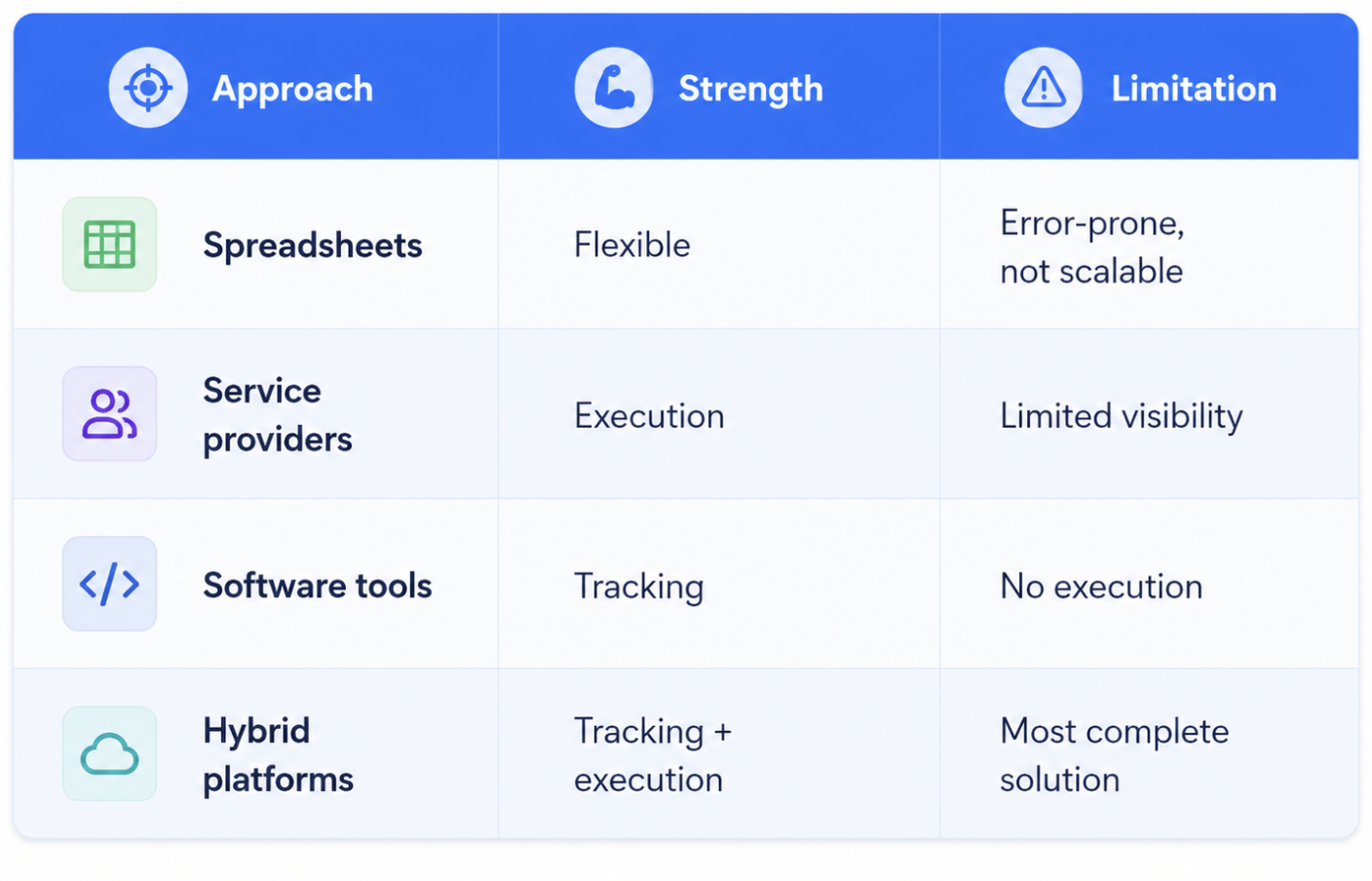
While flexible, spreadsheets quickly become unreliable as complexity increases.
Common issues include:
- Outdated data
- Lack of version control
- Limited visibility across teams
- High risk of human error
External service providers
Many organizations outsource compliance tasks to service providers.
These providers handle:
- Filing submissions
- Registered agent services
- Compliance-related paperwork
While this reduces workload, it introduces new challenges:
- Limited visibility into status
- Fragmented data across vendors
- Reliance on follow-up and communication
Basic software tools
Some organizations adopt software solutions to improve organization.
These tools help with:
- Document storage
- Deadline tracking
- Entity record management
However, most are limited to tracking—not execution.
Limitations of traditional approaches
As organizations scale, these approaches begin to break down.
1. Tracking without execution
Most software tools tell you what needs to be done—but do not actually do it.
This creates a gap between:
- Awareness
- Completion
Teams still need to:
- Coordinate filings
- Work with vendors
- Manage follow-ups
2. Fragmentation across systems
Entity data and compliance activities are often spread across:
- Internal spreadsheets
- External vendors
- Multiple software systems
This leads to:
- Inconsistent data
- Limited visibility
- Increased operational complexity
3. Manual coordination
Compliance often depends on:
- Email threads
- Calendar reminders
- Internal follow-ups
This introduces:
- Delays
- Errors
- Missed deadlines
A new model: software + execution
A newer approach to entity compliance combines:
- Entity management
- Compliance tracking
- Filing execution
Within a single platform.
This model eliminates the gap between tracking and execution.
Instead of:
- Tracking requirements
- Then coordinating work
Organizations can:
Track and complete compliance in one place
Key capabilities of modern entity compliance software
Modern platforms typically include several core features.
Centralized entity management
A single system for:
- Entity records
- Ownership structures
- Documentation
Compliance tracking
Automated tracking of:
- Filing deadlines
- Jurisdictional requirements
- Compliance status
Document management
Storage for:
- Formation documents
- Filing confirmations
- Compliance records
Alerts and notifications
Proactive alerts for:
- Upcoming deadlines
- Required actions
- Compliance risks
Filing execution (advanced platforms)
Some platforms also:
- Complete filings
- Manage registered agent services
- Handle ongoing compliance tasks
This is where newer solutions differentiate themselves.
When do you need entity compliance software?
Organizations typically reach a point where manual processes are no longer sustainable.
Common triggers include:
Managing multiple entities
Once you have more than a handful of entities, tracking manually becomes difficult.
Expanding into new states or countries
Each new jurisdiction introduces new requirements and deadlines.
Increasing compliance risk
Missed filings or lack of visibility create operational and legal risk.
Scaling operations
Growth increases both the number of entities and the complexity of compliance.
Entity compliance vs other approaches
Frequently asked questions
What is the difference between entity compliance and entity management?
Entity management focuses on organizing entity data, while compliance focuses on meeting regulatory requirements. Modern platforms often combine both.
Can entity compliance software replace service providers?
Some platforms can reduce or eliminate the need for multiple providers by integrating execution directly.
What happens if compliance is missed?
Missing compliance can lead to penalties, loss of good standing, or dissolution depending on the jurisdiction.
Is this necessary for small companies?
Not always—but as soon as complexity increases, software becomes critical.
Final thoughts
Entity compliance becomes more complex as organizations grow.
Traditional tools help track requirements—but often fall short when it comes to execution.
Modern solutions focus on combining visibility, automation, and execution—ensuring compliance is both tracked and completed.
See how Filejet manages entity compliance and execution